
We Can't Solve These Crises — We Can Only Grow Out of Them
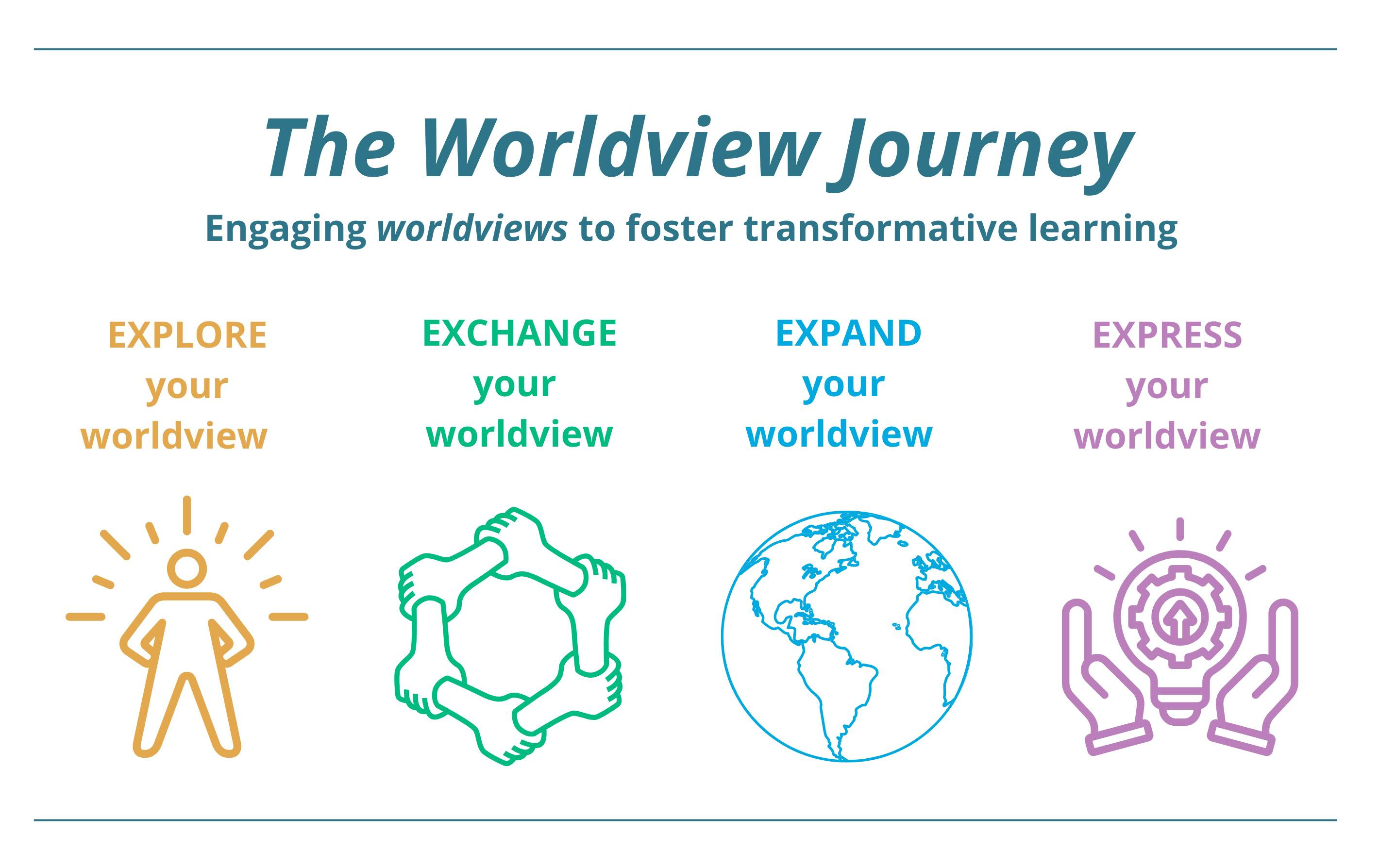
The four fundamental shifts the 'Worldview Journey' invites you into

Many of us feel overwhelmed these days. Overwhelmed by emails and tasks we can’t keep up with. By changes in the world that are increasingly hard to comprehend. By conflicts — with colleagues, family, neighbors — that puzzle and drain us. By the sheer weight of living in a world in crisis.
But there’s a particular kind of calm that comes — not from avoiding the complexity of this time, but from understanding it more deeply.
Not the calm of certainty or control, but the calm of recognizing that many of the issues we navigate daily stem from how we make sense of life and the world itself.
This is my personal experience — a “worldview-lens” gives me a greater sense of coherence, depth, and meaning — but I also heard it reflected back when reading the essays of participants in our recent Worldview Journey Facilitator Training.
One of them described it this way:
“I have become calmer. This calm does not come from indifference, but from an expanded view: when I recognize that people organize the world through different meaning systems, much becomes more understandable — tensions, misunderstandings, and conflicts included.”
This is what worldview literacy makes possible.
And to be clear right away: “literacy” makes it sound like we’re merely talking about knowledge. But life doesn’t work that way, knowledge generally doesn’t actually change us. What changes us — as far as I can tell — is the combination: knowledge + experience + reflection + dialogue.
So this is what I want to explore with you today: What actually shifts when we develop worldview literacy? What are the inner transformations that create this capacity to navigate complexity with greater calm and clarity?
And if you want to explore this in person, come to our live session at the Learning Planet Festival next Tuesday January 27th (19.30 - 21.00 CET)!
Four Fundamental Shifts
The Worldview Journey guides participants through four fundamental shifts in how they relate to themselves, others, the world, and the future:
From unconscious to reflexive
Explore your Worldview — Gain perspective on your perspective
From threat response to learning stance
Exchange your Worldview — Learn to learn from other perspectives
From separation to interconnection
Expand your Worldview — Cultivate a planetary perspective
From values-action gap to aligned living
Express your Worldview — Put your perspective into practice
These shifts don’t happen randomly or simultaneously. They follow a developmental sequence that is easy to recognize in our own experience. We must first ‘see’ our own worldview, before we can truly make space for other perspectives. And we need both self-awareness and relational capacity before we can engage wisely with complex questions about our world and our role in shaping a worthwhile future.
Today, I'll walk you through all four shifts — showing you what each transformation looks like and how our recent participants experienced them. In my next piece in February, I'll go into the HOW, exploring the dialogue practices and embodied learning methods that create conducive conditions for these shifts to take place.
Shift 1: From Seeing Unconsciously to Seeing Reflectively
Explore your Worldview - Gain perspective on your perspective
What shifts:
The first shift is what developmental psychologist Robert Kegan describes as moving something from “subject to object” — from being embedded in and identified with your worldview to being able to look at it.
For most of us, most of the time, our worldview is like water to fish — so omnipresent, so fundamental to our experience, that it becomes completely invisible. We don’t see our worldview; we see with our worldview. It shapes what appears real, what seems valuable, what feels possible, how we interpret events, and what solutions we consider. These are the glasses we look through, framing and coloring our experience without us even noticing them.
This first shift is recognizing that your worldview is not “reality” but a particular way of organizing reality. You begin to see how your assumptions, values, and beliefs shape what you notice, what you’re open to, what you dismiss, and how you orient your life.
What it looks like:
Participants described this shift in remarkably similar language:
“The fundamental shift that the program repeatedly helped to initiate: from ‘seeing with a worldview unconsciously’ to ‘seeing with a worldview reflectively.’”
Another described discovering their worldview with a mix of recognition and surprise:
“I had ambivalent feelings about the outcome: Integrative worldview. It seemed to fit well with my ideas about my values and perspectives but also felt a bit ‘in the future’, as if I was not living up to my own ‘worldview’ yet.”
And another noticed how quickly this awareness began showing up in daily life:
“As the weeks went by the different worldviews became more concrete and tangible for me. I started ‘seeing’ them in action around me and in myself.”
This isn’t just intellectual understanding. It’s a lived recognition that changes how you move through the world. When you see how you make sense — not just what you think — you gain a metacognitive freedom: an ability to ‘think about your thinking’.
You’re no longer wholly controlled by your assumptions but you can observe them, witness them in action. And this introduces a new freedom: you can now choose how to relate to what you notice. You can ask: Is this assumption still serving me? What would happen if I held this more lightly?
But recognizing your worldview is just the beginning. The real test comes when that worldview is challenged by someone who sees things fundamentally differently.
Shift 2: From Threat Response to Learning Stance
Exchange your Worldview — Learn to learn from other perspectives
What shifts:
When we encounter perspectives that conflict with our own — especially on issues we care deeply about — our nervous system may register this as a threat to our survival. After all, our worldview isn’t just a set of ideas; it’s intimately tied to who we understand ourselves to be, what groups we belong to, and how we maintain meaning, order, and stability in our lives.
So a challenge to our worldview is an “identity-threat”. And it tends to trigger our alarm system response — readying our organism to fight, flight, freeze, or fawn. Without our conscious awareness, the nervous system diverts our energies to secure our survival: blood flow and oxygen towards our limbs (so we can run away or put up a fight) and away from our neocortex (which makes learning and reflection possible).
We can recognize these mechanisms in the predictable responses that have become all too familiar in public discourse: defensiveness, dismissiveness, withdrawal, aggressive argumentation. We go into what one participant called “alarm bell mode” — focused on protecting ourselves rather than learning or understanding the other.
The second shift involves learning to notice this threat response while it’s happening and to proactively work with it. The breath, for example, can be a powerful pathway to turn off the alarm response. As we consciously engage this process, we expand our capacity to stay open under pressure, to learn from challenge and criticism, to cultivate a growth mindset.
This is learning to learn from other perspectives — not necessarily agreeing with them, but remaining open enough to understand what becomes visible through another pair of eyes. Even if we passionately disagree with others, having a deeper understanding of what we disagree with is going to help us respond in more constructive ways.
What it looks like:
Several participants identified this as one of the most crucial insights:
“Two insights were especially impactful in understanding what gets in the way of healthy worldview exchange. The first was the concept of identity threat — how our nervous systems go into alarm when our worldview feels challenged. Learning how this threat response can be met through both a growth mindset and nervous system regulation was highly valuable for me as a facilitator and leader.”
Another described recognizing their own pattern:
“I do experience ‘criticism’ on my worldview as ‘criticism’ on myself, and that brings on the ‘alarm bells’ quite often. And yes, I try to avoid it, and shy away from criticism, instead of treating it as an open door, a learning opportunity.”
But she also described the shift that became possible:
“I hope to stay open and curious a bit more in the future... to recognize the alarm phase better and ‘use’ it as a trigger to stay open and curious.”
One participant noticed a tangible change in their behavior:
“I noticed a shift in myself. I feel increasingly able to listen without immediately wanting to react, or worse ‘jump in’, and when I speak, to speak without expecting confirmation or approval.”
One participant beautifully articulated what becomes possible when we make this shift not just individually but collectively:
“I very strongly believe that these connections are essential to addressing the challenges we are facing as humanity, and to enable diverse worldviews to become a source of energy, wisdom and creativity rather than a source of conflict and stagnation.”
This is the promise of the second shift: that difference can become generative rather than destructive, that we can engage constructively across worldview divides without requiring agreement or sameness.
These first two shifts form the relational foundation. But they naturally call us toward a larger question: once we understand ourselves better and can engage with others more constructively, how do we relate to the world itself?
Shift 3: From Separation to Interconnection
Expand your Worldview — Cultivate a planetary perspective
What shifts:
Most of us have been deeply informed by the modern worldview, which understands reality mechanistically, sees humans as separate from nature, views our current crises as a collection of isolated problems to be solved, and understands progress primarily as technological and material advancement.
The third shift invites people to explore their relationship with the world around them, particularly nature. It examines how different worldviews have tended to understand and relate to nature, inviting people into a deep contemplation on their own sense of nature-connectedness.
It also suggests humans’ fundamental embeddedness within a much larger ‘story’ — seeing ourselves not as separate individuals acting upon nature, but as expressions of, and participants in, a vast, ongoing evolutionary process that gave rise to life itself, to consciousness and culture, and to our very capacity to reflect on these questions.
This isn’t about romanticizing nature or rejecting modernity, but about seeing a bigger picture: understanding why the modern separation from nature was developmentally necessary (allowing us to develop science and technology, liberal democracy and human rights), and recognizing that we’re now called to reintegrate what was separated — to recover our sense of kinship with the more-than-human world without losing the gifts modernity brought.
What it looks like:
One participant described this evolutionary understanding as bringing peace:
“I’ve also gained a lot of knowledge and background on .. human development. The realization that there are different steps, or at least a direction in which humanity can move, and that you really have a different framework and almost a different language when you’re at a different step, is very helpful in daily life. … Insight in the different worldviews and how these evolved over time … gives me so much peace and understanding when looking at the world nowadays.”
Another captured the journey beautifully through poetry:
“Einstein wrote, ‘Our task must be to free ourselves from this prison [of separation] by widening our circle of compassion to embrace all living creatures and the whole of nature in its beauty.’
And Rilke’s poem: ‘I live my life in widening circles / that reach out across the world.’”
The program includes a guided nature walk that helps make this shift visceral, not just conceptual. One participant described a revelation during this walk:
“In the nature walk I was intrigued by the idea that what humans make is in a way just as natural as a bird’s nest. This allowed me to be less irritated by human-made ‘things’ that I felt were interrupting my experience of nature.”
And another made a personal commitment born from this recognition:
“I discovered that I would like to invest more into my connection with nature. I love nature and nature cares for me but I have been neglecting direct contact with nature.”
This third shift fundamentally changes our sense of identity and responsibility. We’re not separate managers of nature or fixers of problems from outside the system. We’re participants in an unfolding story, with all the humility, wonder, and accountability that comes with understanding our place in the larger web of life.
But expanded awareness alone isn’t enough. The question becomes: how do we actually live in alignment with this understanding?
Shift 4: From Values-Action Gap to Aligned Living
Express your Worldview — Put your perspective into practice
What shifts:
We’ve all experienced it: we know what we believe and value, but somehow we don’t act accordingly. We want to change certain habits in our life, but just can’t seem to do it, however hard we try. We care deeply about the climate but take unnecessary flights. We value authentic relationships but spend hours scrolling. We want to contribute meaningfully but stay in soul-draining work that exhausts us.
This isn’t hypocrisy or weakness. It’s what psychologists Kegan and Lahey call “immunity to change” — we have hidden commitments that work against our stated values. These protective mechanisms operate largely unconsciously, rooted in our organism’s fundamental drive for safety, belonging, and competence.
The fourth shift involves bringing these hidden dynamics to light. When we understand why we’re not acting in alignment — what we’re actually protecting or afraid of losing — we can begin to work with these patterns rather than exhausting ourselves fighting against them. We discover that alignment isn’t about willpower but about understanding and compassion for our own protective mechanisms.
What it looks like:
The program includes a practice of duo coaching (or peer coaching) where participants support each other in examining these hidden commitments. One participant called this practice “life-changing”:
“I really enjoyed the worldview interview and the coaching; the real human-to-human communication and learning together. It was really exciting and life-changing.”
The emphasis throughout is on embodied transformation — shifts that go beyond intellectual understanding:
“Inner development is not about collecting more and more knowledge. We already have that in abundance as humanity. It’s about mindshifts that are not only understood but also lived—that sink into the body, into the nervous system, into how we react under pressure. Only then do they become sustainable.”
And the proof shows up in immediate action. Multiple participants began applying their insights professionally even before the program ended:
“I am going to (re)develop a personal/professional development course for our master students based on the rich learning outcomes of this course. So, yes, worldviews and generative dialogue will become important elements in the course.”
“Together with two colleagues … we’re going to work on how to integrate this within healthcare.”
“I’ve pitched it as elective education; I’ve already signed up to give a worldview workshop at our conference.”
One participant beautifully captured the dual nature of what can emerge:
“What I take from the program is twofold: a personal clarification and a professional perspective. Personally, I carry more awareness of how I construct meaning — and more calm in relating to life and to difference. Professionally, I take a solid set of methods and stances to enable reflection and dialogue in groups.”
This final shift is about integrity in its deepest sense — becoming more whole, integrated, and aligned. Increasingly able to live in accordance with what we understand to be true and important, closing the gap between who we’re becoming and how we show up in the world.
How These Shifts Actually Happen
To be clear, these shifts are not immediate nor ever really finished. This is ongoing work, resulting in a perpetual deepening. This is also why several people who took the course for the 2nd time reported back that it was (again) fresh and different this time.
We can engage these shifts wherever we are in this process, and we can take the different practices into both our daily life and our professional contexts, continuing the work after the course ends.
In my next newsletter I’ll unpack the dialogue practice that participants consistently describe as “breakthrough experience”, the embodied learning methods that help insights sink in beyond the cognitive level, and the role of community in sustaining transformation. One participant captured it well:
“What I enjoyed most — and what surprised me — was how strong the impact of a few well-chosen methods can be. I experienced that deep learning does not necessarily require ‘more input,’ but often better conditions: time, structure, safety, presence, and a format that takes inner processes seriously.”
In February, I’ll talk about those conditions and how you can begin creating them yourself — including through a dialogue workshop we’re offering in March.
Two Invitations
If these four shifts seem valuable to you, I have two invitations:
Join our session at the Learning Planet Festival (Free)
On January 27th (19:30-21:00 CET), we’ll offer an interactive session where you’ll:
Understand what worldviews are and why they’re crucial for responding to our world in crisis;
Experience a short Stream-of-Consciousness dialogue practice;
Connect with others asking similar questions about growth, meaning, and how to show up skillfully in these times;
Learn about the full Worldview Journey program.
This is a chance to see if this work resonates before committing to the full program.
Take the Full Worldview Journey (May 11 - June 29 2026)
Unlike many inner development programs that focus solely on individual growth, the Worldview Journey is designed to cultivate capacities specifically needed for engaging with difference, complexity, and collective challenges.
The complete program includes:
Four live online sessions + a bonus integration session (5 x 2 hours each);
Seven guided, deep dialogical encounters across the program;
One year of access to the full Worldview Journey learning materials;
Videos, reflection prompts, journaling exercises, and experiential practices;
An intimate international learning community, held with care and intention.
Early bird pricing available through March 31st.
A Closing Thought
We live in times that demand more than intellectual understanding or technical solutions. As some say, we can’t solve these crises, we can only grow out of them.
The four shifts the Worldview Journey supports — from unconscious to reflexive, from threat response to learning stance, from separation to interconnection, from values-action gap to alignment — cultivate foundational capabilities for anyone who wants to show up skillfully in our complex, polarized, rapidly-changing world.
And here’s what I find most hopeful: these shifts are learnable. Not easy, not instant, but genuinely possible through practice, community, and commitment.
With a fierce commitment to growth, dialogue, and our collective flourishing,
Annick
P.S. If you want to dive deeper into the research behind this work before joining, you can explore our publications here. But my invitation is: start with the experience. The theory makes more sense once you’ve felt the shift.
P.P.S. One participant captured something many others echoed: “For me personally, the greatest impact was the regular meeting of more or less likeminded people working towards making the world a better place. This gives me hope.” In times of isolation and despair, finding others engaged in the same work of growth turns out to be essential.
The Worldview Journey is an evidence-based program developed in collaboration with Utrecht University and grounded in two decades of both academic research and personal exploration into worldviews and transformative change-making. It integrates insights from developmental psychology, cultural evolution, sustainability science, educational theories, and contemplative practice, to name just a few.